Blog
Where to find public tenders in France? A comprehensive overview of sources
by Alexandre Guillemot 8 min read
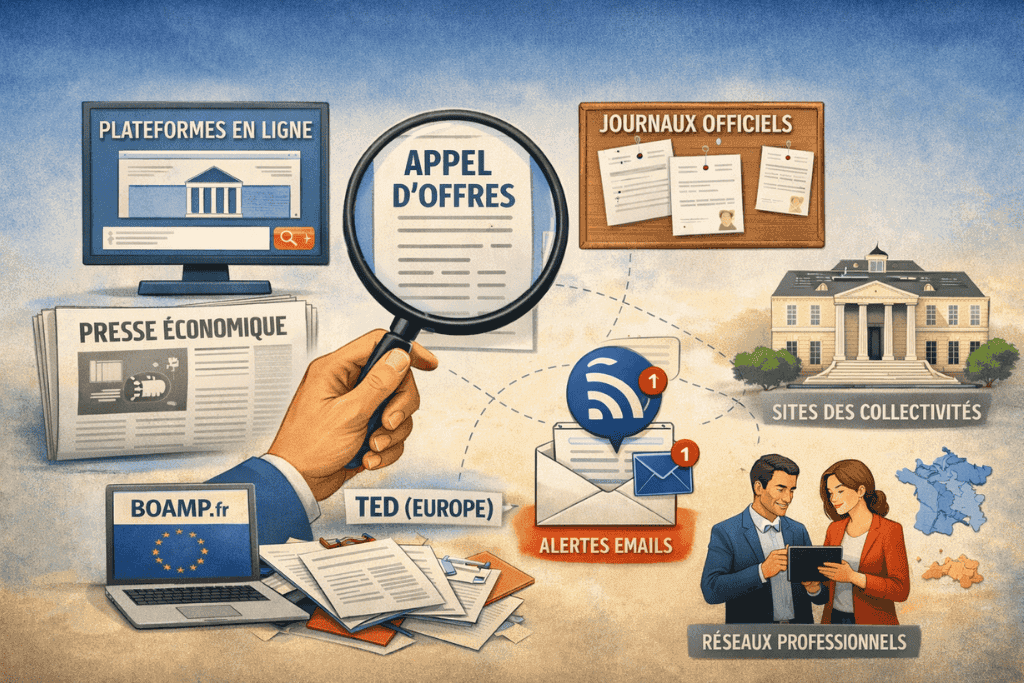
Public tenders in France are published across a fragmented ecosystem of over 300 platforms, primarily including BOAMP (national), TED (European), and PLACE (State), along with regional “Buyer Profiles” and local legal newspapers.
Access to public tenders such as photovoltaic tenders in France is often underestimated. Many companies believe that one or two platforms are sufficient to cover all opportunities, whereas the French system relies on a multiplicity of publication channels, each with its own scope, rules, and limitations. Identifying the right sources is therefore a prerequisite for any effective tender monitoring strategy.
This article provides a structured and operational overview of the main sources used to find public tenders in France. Its objective is to offer a clear view of the truly essential platforms, while also explaining why none of them, on its own, can guarantee exhaustive coverage.
1. How public tenders are published in France
In France, public tenders are published according to regulatory thresholds, types of contracts, and practices specific to each contracting authority. Some notices are published at the national level, while others are available only through local or specialized platforms. European publications are also added for contracts exceeding EU thresholds.
This fragmentation explains why major projects where public tenders are necessary, whether related to dams public tenders, hydraulic engineering services public procurement, or logistic and supply chain public tenders, soil pollution tenders and hazardous waste tenders , may appear on very different channels, sometimes difficult to identify without a detailed understanding of the ecosystem.
2. National sources for finding public tenders in France
The BOAMP (Bulletin Officiel) remains the primary legal database for French public procurement, yet it must be supplemented by TED for contracts exceeding EU thresholds.
Certain platforms play a central role in the dissemination of public procurement opportunities at the national level. They form the foundation of any serious monitoring approach in France.
The BOAMP (Bulletin officiel des annonces des marchés publics) is the institutional reference. It publishes a large share of contract notices issued by French public buyers. Its scope is broad but not exhaustive: some contracts, particularly those below regulatory thresholds or highly specialized ones, may not appear there.
For certain sectors, particularly energy and infrastructure, using the BOAMP effectively requires a good understanding of contract typologies, thresholds, and publication practices. This aspect is detailed in the article How to use energy tenders on BOAMP, which provides a concrete illustration of how to leverage this source to identify relevant sector-specific opportunities.
The Marchés Online platform publishes a large number of public and semi-public tenders, often in addition to BOAMP. It is frequently used by local authorities and public institutions.
La Centrale des marchés aggregates tenders from various contracting authorities and serves as a useful complementary source, particularly for certain service and works contracts.
For contracts exceeding European thresholds, publication takes place at the EU level via TED Europe (Tenders Electronic Daily). This source is essential for large, structuring projects, especially in the infrastructure, energy, and environmental sectors.
The PLACE website, the central procurement platform of the French State, is used by many ministries and national public institutions. A significant share of State tenders is accessible only through this platform.
Private or semi-institutional platforms also play an important role, such as e-marchespublics and Marchés Sécurisés, which host buyer profiles for numerous local authorities and public operators.
Beyond published tenders, there are also sources that make it possible to identify public purchasing projects upstream that is, purchasing intentions that may eventually evolve into formal tenders. These projects provide early visibility into the future needs of public buyers, well before official publication. In France, the APProchE portal, freely accessible via the PLACE platform, allows users to consult these public purchasing projects and better anticipate upcoming opportunities. This approach is particularly useful for companies seeking to position themselves early on complex or structuring projects, before they are transformed into tenders published on dedicated platforms.
3. Regional and territorial public procurement platforms
Alongside national sources, each region or territorial grouping has its own publication platform. These sites are essential for identifying local, technical, or sector-specific contracts that are not always relayed elsewhere.
The Brittany region relies on the Megalis Bretagne platform, which centralizes numerous tenders issued by Breton local authorities and public institutions.
In Île-de-France, the Maximilien platform plays an equivalent role and is an essential source for tenders in the Paris region, particularly in the fields of engineering, infrastructure, and urban services.
The Grand Est region also has its own regional platform, used by many territorial contracting authorities.
Similar platforms exist across all French regions (Auvergne-Rhône-Alpes, Nouvelle-Aquitaine, Occitanie, Hauts-de-France, Pays de la Loire, PACA, etc.), each covering a specific geographic area and sometimes differing publication practices.

Regional platforms like Maximilien (Paris region) or Megalis (Brittany) act as essential aggregators for local public contracts that may not appear on national portals.
4. Local sources: municipalities, inter-municipal bodies, and local publications
Localized tender monitoring in France requires tracking individual ‘Buyer Profiles’ (Profils d’Acheteur) used by smaller municipalities for low-value contracts.
Beyond national and regional platforms, some tenders are also published at a very local level, directly by territorial authorities, communities of municipalities, urban communities, or town halls. In such cases, notices may appear on the official website of the authority, sometimes within a section dedicated to public procurement or ongoing consultations. This practice mainly concerns low- or medium-value contracts, recurring services, or highly localized projects. These local publications, while perfectly valid, are often difficult to identify without fine-grained monitoring, as they are not systematically relayed in a visible way on major national platforms.
Press monitoring is also a complementary source that should not be overlooked. In France, there is an official list of authorized legal announcement newspapers allowed to publish public procurement notices. Some tenders, particularly at the local level, may be published in these outlets, either alongside or in addition to digital platform dissemination. It is important to note that these publications frequently overlap: the same tender may be published simultaneously on BOAMP, on a regional platform, on a buyer profile, and in some cases on a municipality’s website or in a legal announcement newspaper. This overlap of channels illustrates the complexity of the French landscape and explains why effective monitoring relies as much on aggregation and deduplication as on simply multiplying the sources consulted.
5. Decisive sources for certain technical sectors
Depending on the sector of activity, some sources become particularly important. Airport infrastructure projects are often published via specialized buyer profiles or platforms linked to airport operators. Tenders related to dams and major hydraulic works frequently combine national, European, and specialized buyer-profile publications.
Markets for hydraulic engineering, soil pollution, or hazardous waste are often integrated into broader works or environmental services contracts, with scopes described in a highly heterogeneous manner. Their identification rarely relies on a single source or a simple keyword.
6. The limits of manual tender searches
Even with a precise understanding of all these platforms, manual monitoring quickly reaches its limits. The multiplication of websites to consult, duplicate publications, difficulties in analyzing technical documents, and the absence of a cross-platform search engine make this approach poorly scalable.
These limitations become particularly evident as soon as the scope exceeds a limited territory or when volumes increase, as explained in the article Manual tender monitoring vs automated monitoring: real gains and limitations.
Finding public tenders in France therefore requires aggregating all these sources, understanding their complementarities and blind spots, and structuring information over time. This approach is all the more important for companies also operating internationally, where publication practices differ significantly, as detailed in Tender monitoring: key differences between France and international markets.
In this context, implementing a structured tender monitoring approach helps centralize these different sources, track public contracts and award notices, and anticipate upcoming projects.
Manual tender monitoring in France is hindered by high publication overlap and the lack of a unified, cross-platform search engine for technical documents.
To solve this fragmentation, Deepbloo centralizes hundreds of national and regional sources into a single, AI-filtered dashboard, eliminating the risk of missing a strategic local tender.
How to find public tenders in France efficiently
- Identify the thresholds: Determine if your target market falls under national or European mandatory publication.
- Select your hubs: Register on PLACE and BOAMP for major national projects.
- Target local regions: Set up alerts on regional portals like Maximilien if your business is location-specific.
- Use an aggregator: Centralize all sources using a tool like Deepbloo to manage deduplication and document analysis.
7. Conclusion: why no single source is sufficient on its own
There is no single source capable of identifying all public tenders in France. The richness of the French system lies in a plurality of national, regional, and sector-specific platforms, each covering only part of the existing market. The performance of a monitoring strategy therefore depends less on consulting a single website than on the ability to structure, cross-reference, and analyze these sources according to one’s sector, geographic scope, and actual capacity to respond.
Frequently asked questions
Where are all French public tenders published?
There is no single site. They are split between national (BOAMP and PLACE), European (TED), and hundreds of regional buyer profiles.
Is access to French public tenders free?
Yes, consulting notices and downloading Tender Documents (DCE) is free on all official French platforms.
What is the best site for regional tenders in France?
It depends on the region. For Île-de-France, use Maximilien; for Brittany, use Megalis.
How do I find tenders below the legal thresholds?
Smaller contracts (MAPA) are often only published on the buyer’s website or in legal newspapers (JAL).