Blog
Commercial intelligence: AI, APIs & MCP for tenders
by Alexandre Guillemot 13 min read
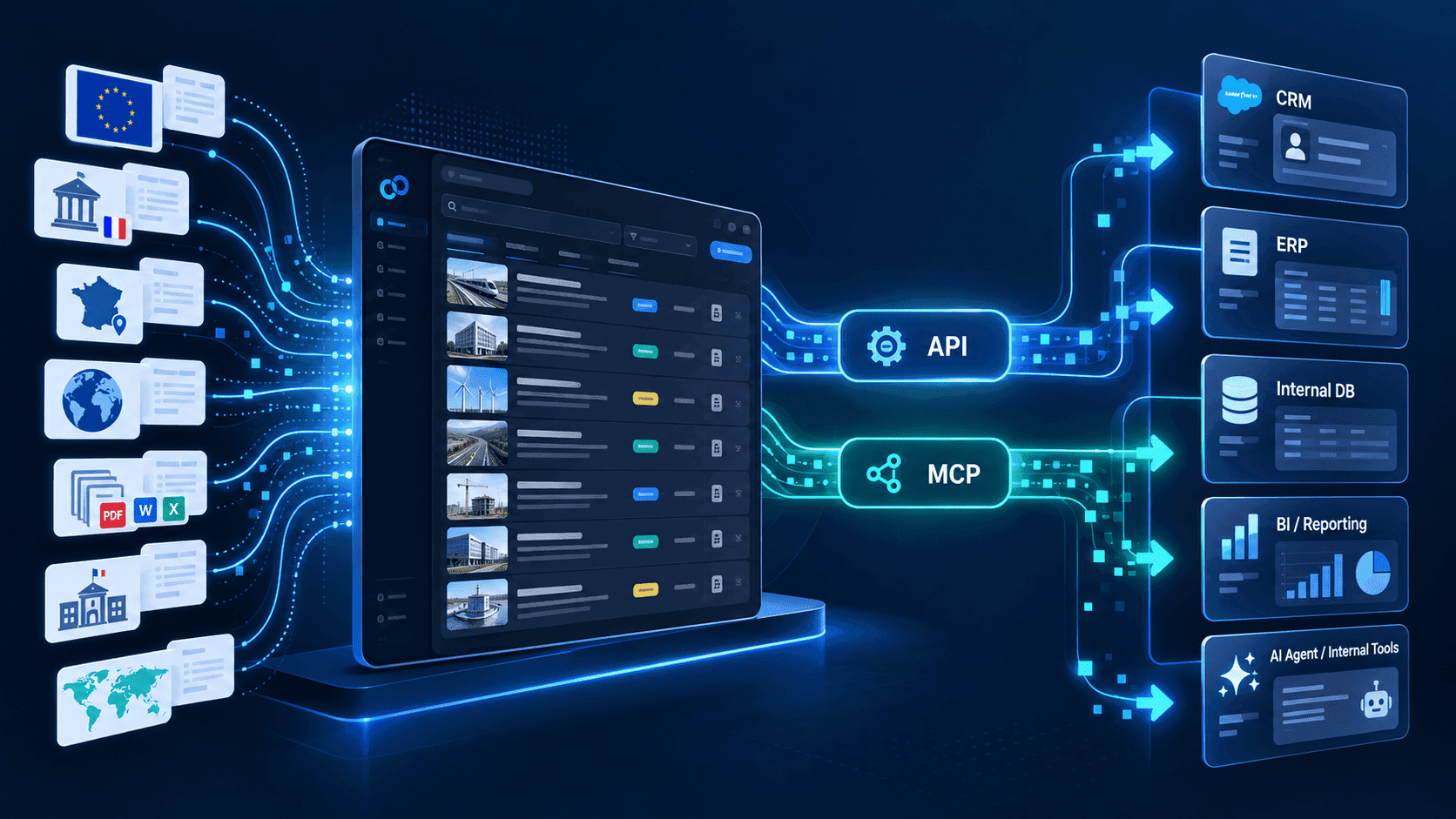
Connected commercial intelligence allows the integration of tenders, private projects, and qualified data directly into companies’ business tools and AI agents.
For a long time, tender monitoring relied on a relatively simple operation: companies subscribed to a specialised platform, configured their alerts, consulted new opportunities, downloaded documents, and decided which tenders to respond to.
This model remains useful. But usage is evolving rapidly. Companies now have CRMs, information systems, document analysis tools, and, increasingly, AI assistants capable of leveraging their own data.
The question then arises: why consult a monitoring software, download a file, and then manually transfer it to another tool for further analysis?
APIs and MCP connectors open up another possibility: directly circulating data between commercial intelligence and the tools used daily by teams.
However, this evolution rests on a fundamental distinction, often underestimated: identifying and qualifying opportunities on one side, analysing files and preparing responses on the other. These two tasks have neither the same technical constraints nor the same needs.
1. Why does tender collection remain a specialised task?
Collecting tenders on a large scale requires an infrastructure capable of daily monitoring heterogeneous sources, retrieving documents, and transforming publications into reliable data.
When a company searches for public tenders, it can consult national portals like BOAMP, buyer profiles, regional platforms, or local authority websites. Internationally, sources multiply further, with different languages, publication formats, and dissemination rules.
In addition to this, there is upstream information: deliberations, public inquiries, administrative authorisations, environmental decisions, private projects, investment announcements, or institutional publications.
Comprehensive commercial intelligence for a given scope therefore implies much more than just searching a few websites.
This complexity explains the differences between manual and automated tender monitoring, particularly in terms of coverage, reliability, and time spent on collection.
From collection to exploitable data
The difficulty is not limited to retrieving information.
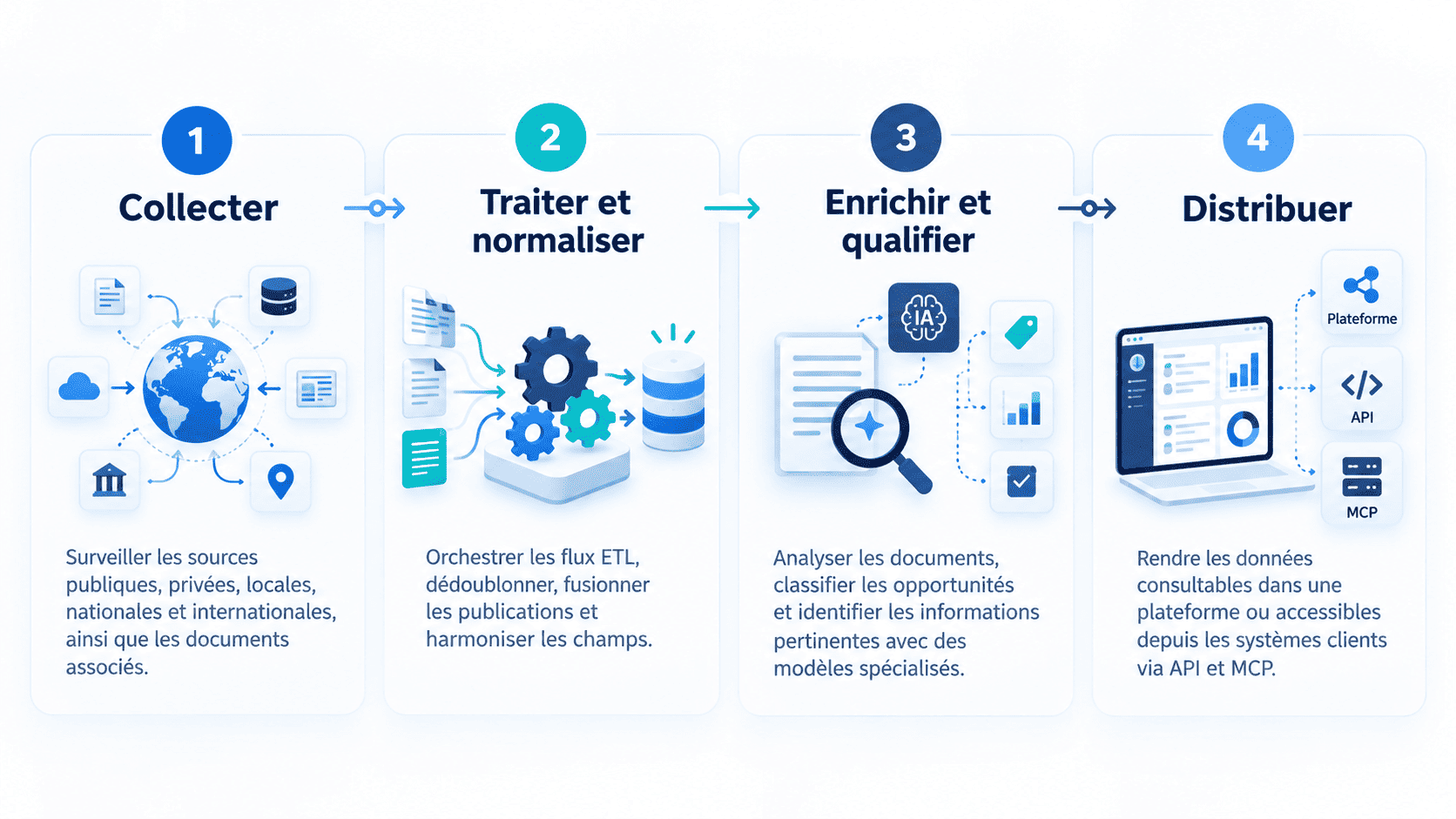
A monitoring infrastructure must be capable of chaining several operations:
-
Collect: Monitor public, private, local, national, and international sources, as well as associated documents.
-
Process and standardise: Orchestrate ETL flows, deduplicate, merge publications, and harmonise fields.
-
Enrich and qualify: Analyse documents, classify opportunities, and identify relevant information with specialised models.
-
Distribute: Make data searchable in a platform or accessible from client systems via API and MCP.
Collection does not stop after a first publication. The same tender can appear on several sources, with documents published or updated at different times. The database must therefore be updated, reconciled, and enriched over time.
Extraction, transformation, and loading operations, often referred to by the acronym ETL, require permanent technical orchestration. It is necessary to monitor processing, correct errors, adapt connectors when websites evolve, and control the quality of the information obtained.
Why don’t AI agents easily replace this infrastructure?
An AI agent can search for information on the Internet, consult a page, or analyse a document. But performing these tasks occasionally is not the same as operating a reliable infrastructure covering hundreds or thousands of sources every day.
The challenge lies in large-scale repetition: source availability, different formats, multiple documents, structural changes, duplicates, updates, and quality control.
Developing a comparable in-house infrastructure implies skills in web crawling, data engineering, storage, document processing, AI models, and technical operation. For a company, even a large one, development and maintenance costs can quickly become significant.
AI agents can contribute to some of these operations. They do not eliminate the need for an industrial collection and qualification infrastructure.
Key takeaway
The value of a tender aggregator relies as much on the reliability, freshness, and structuring of its data as on its search engine.
2. After detection, a second task: analysing files and preparing responses
Tender analysis consists of using consultation documents to assess the relevance of a market, understand its requirements, and prepare an appropriate response.
Once an opportunity is identified, the nature of the work changes.
Teams must examine the invitation to tender (RC), the technical specifications (CCTP), the administrative clauses (CCAP), annexes, price schedules, contractual documents, and any additional documents.
The initial objective is often to decide whether or not the company should respond. This is the go/no-go phase, which is based, in particular, on analysing technical requirements, the timeline, necessary resources, requested references, and selection criteria.
But the work doesn’t stop there.
For a tender deemed relevant, teams must understand the buyer’s detailed expectations, align requirements with their own skills, identify risks, and build a coherent response.
AI opens new uses in document analysis
Artificial intelligence models can support a significant part of this work:
- Produce a summary of the consultation file and its main requirements.
- Compare market criteria with the company’s skills and references.
- Identify points of attention, missing documents, and contractual constraints.
- Prepare a technical memo outline or a first draft of certain content.
- Facilitate the review of responses before validation by teams.
However, these uses require having the right documents and an adapted business context. Automated analysis does not exempt from verifying information, respecting confidentiality requirements, and having decisions validated by competent individuals. To delve deeper into these uses, discover how artificial intelligence transforms the monitoring and analysis of tenders, from qualifying opportunities to exploiting consultation documents.
Crucially, the tools used for this work are no longer necessarily those used to discover the tender.
Some companies adopt SaaS software specialising in public tender analysis and response. Others develop internal AI agents, connected to their documents, commercial references, and validation processes.
Key takeaway
Opportunity detection and response preparation are two complementary tasks, but companies can choose different tools for each.
3. API and MCP: how to integrate commercial intelligence with internal tools?
An API allows one IT system to exchange data with another service. MCP allows compatible applications and AI agents to access external data and tools within a standardised framework.
These two mechanisms address different uses but contribute to the same evolution: making intelligence accessible beyond a platform’s interface.
APIs for automating data flows
An API can enable a company to integrate opportunities into its CRM, internal software, or document management environment, subject to available functionalities and rights.
Every day, the intelligence system detects tenders matching its activities. Rather than asking several employees to consult a platform and re-enter information, an API flow can directly feed its commercial system.
Each opportunity can then be associated with a country, sector, buyer, deadline, amount when available, and consultation documents.
The company can trigger its own qualification rules, assign the file to a team, and maintain a history in its information system.
The benefit is not only to eliminate a manual step. The API allows the processing of opportunities to be reproducible, traceable, and exploitable on a larger scale.
MCP for connecting AI agents to commercial intelligence
Model Context Protocol (MCP) addresses a similar need, with a particular orientation towards AI assistants and agents.
When a service exposes tools and resources via MCP, a compatible AI application can, depending on the permissions granted, query that service and use the results to accomplish a task.
A user could thus ask their assistant:
“Identify tenders published this week in waste treatment in France, select those that match our activity, and prepare an initial analysis of the files.”
To respond correctly, the agent must have access to an up-to-date database, business criteria, and, when necessary, associated documents.
An MCP connector can play this interface role between the AI agent and the data provider. The agent then retains its work environment, while information comes from an infrastructure specialising in intelligence. The MCP protocol transforms commercial intelligence: it is no longer about pushing email alerts, but about exposing real-time market context directly queryable by the company’s AI model.
| Criterion | API | MCP |
|---|---|---|
| Primary Use | Data exchange between software | Access to data and tools by compatible AI applications |
| Example | Automatically feed a CRM | Query intelligence from an AI assistant |
| Value | Process automation | Natural language interaction and tool orchestration |
| Common point | Utilise data without re-entry | Utilise data without re-entry |
API and MCP are therefore not opposed. An MCP connector can, moreover, rely on an existing API.
Key takeaway
APIs automate data flow, while MCP facilitates its use by AI agents. In both cases, the quality of available data remains crucial.
4. From intelligence software to integrated data: how are uses changing?
Commercial intelligence is evolving towards a model in which opportunity data is directly exploited in companies’ commercial, documentary, and decision-making systems.
Until now, the classic journey was relatively linear. An employee opened an intelligence platform, consulted announcements, selected a tender, downloaded the file, then transmitted the information to the relevant teams.
Specialised interfaces retain all their utility, particularly for exploring a market, discovering new opportunities, and adjusting search criteria.
But for structured organisations, the multiplication of tools creates increasing difficulty: each transition from one software to another requires manipulations, downloads, or re-entries. These breaks in information processing are among the difficulties that explain why companies can still miss tenders in France, even when announcements are accessible.
With API or MCP integration, a large part of these exchanges can be automated.
A concrete example: processing a tender
Imagine a company of 200 employees specialising in waste treatment and recovery, present in several European countries.
Without integration
- Consult several sources or an intelligence platform.
- Identify and select relevant announcements.
- Download documents.
- Create an opportunity in the CRM.
- Import the file into the AI analysis tool.
- Transmit results to teams.
With integration
- The platform collects, consolidates, and qualifies announcements.
- Relevant data is transmitted to the CRM.
- Documents are made accessible to the internal system.
- An AI agent prepares an initial analysis according to business criteria.
- Teams validate the decision and continue the response.
 Data can now circulate between systems without each employee having to repeat the same manipulations.
Significant gains can be achieved, particularly for organisations that process a large number of opportunities each month, have multiple teams, or need to apply consistent procedures across different countries.
The challenge goes beyond mere ease of use. By reducing manual transfers, the company can shorten the time between a market’s publication, its qualification, and the decision to mobilise a team.
Towards intelligence accessible to the entire organisation
Another change concerns the usage model.
Historically, access to intelligence platforms often relies on licences assigned to a determined number of users. This approach suits specialised teams.
In a larger organisation, data can also interest sector managers, regional directors, technical teams, analysts, account managers, or general management.
Integration can facilitate this dissemination by allowing different employees to work from their own tools.
This does not necessarily mean the disappearance of licences or subscriptions. Economic models can evolve towards formulas combining users, data volumes, API calls, geographical scopes, and associated services.
Key takeaway
Commercial intelligence integration reduces repetitive manipulations and disseminates information into more business processes, without imposing the same software on all teams.
5. Why is structured data essential for AI agents?
An AI agent can only correctly analyse tenders if the transmitted information is sufficiently complete, up-to-date, consistent, and linked to the correct documents.
Connecting artificial intelligence to a tender database is not enough to guarantee the relevance of its responses.
The same tender can be published on different platforms. One publication may contain partial information, while another contains additional annexes. A corrigendum may modify the deadline or certain requirements. Headings can be ambiguous, and classifications insufficiently precise.
Without prior processing, these difficulties are directly transmitted to the system exploiting the data.
The agent then risks working on an incomplete file, counting the same tender multiple times, or missing crucial information.
Data quality becomes a competitive advantage
For companies, several elements are essential: unique identification of opportunities, reconciliation of publications, document retrieval, harmonisation of fields, updating of information, and the ability to filter markets according to sectoral criteria.
An upstream prepared database allows AI models to focus on higher value-added tasks: analysing buyer needs, evaluating suitability with the company’s offer, or preparing a response.
AI connected to structured commercial data can be much more useful than AI tasked with finding dispersed information on the Internet itself, with each request.
This is precisely the desired complementarity between the two tasks: a specialised infrastructure that collects and prepares information, and then the company’s own tools that exploit it.
Deepbloo: combining intelligence infrastructure and integration with business tools
Deepbloo fits into this approach by combining tender monitoring in France, monitoring international markets, detecting private projects, and analysing collected information.
The platform aims to transform dispersed publications into consolidated, enriched, and exploitable opportunities. The work of collection, source reconciliation, and document analysis thus constitutes an essential part of the value delivered.
With API and MCP integration possibilities, this logic can extend to commercial environments and AI agents used by companies.
Depending on the chosen integration methods, teams can exploit intelligence data in their internal processes rather than multiplying downloads and re-entries.
The objective is not to replace existing tools, but to allow each company to organise its own opportunity processing by relying on a specialised infrastructure.
For companies operating in several sectors, access to tender intelligence solutions by activity also provides a starting point for defining the data and business criteria to integrate.
Key takeaway
The industrialisation of commercial intelligence relies on two complementary capabilities: producing quality data at scale and enabling companies to exploit it in their own tools.
Conclusion: Towards more open and better integrated commercial intelligence
The transformation of commercial intelligence is not limited to the arrival of new artificial intelligence functionalities.
It reflects a deeper evolution in how companies access information and organise their commercial decisions.
The collection of public tenders, private projects, and upstream signals remains an industrial task, relying on specialised infrastructures. In-depth analysis of files, qualification of opportunities, and preparation of responses constitute a second task, increasingly integrated into internal tools.
APIs and MCP create a link between these two worlds.
As companies develop their own AI agents, the ability to directly access complete and structured data could become as important as the functionalities offered by traditional interfaces.
The future of commercial intelligence is not about choosing between software and data. It is about being able to use both, in the right place and at the right time.
In summary
- Large-scale tender collection requires an infrastructure for monitoring, processing, and qualifying data.
- Document analysis, go/no-go decisions, and response preparation form a complementary task.
- APIs allow the integration of opportunities and documents into information systems.
- MCP facilitates the connection of AI agents to compatible intelligence services and data.
- Companies can reduce downloads, re-entries, and breaks between their tools.
- The quality, exhaustiveness relative to the monitored scope, and data updates remain essential.
- Specialised platforms are gradually evolving from consultation interfaces to providers of integratable data and services.
Frequently asked questions
What is the difference between tender monitoring software and a tender response tool?
Monitoring software primarily serves to detect, centralise, and qualify opportunities. A response tool comes into play after market selection to analyse the file, prepare documents, and assist with offer drafting. Both functions can be combined in one solution or handled by distinct tools.
Why is tender collection difficult to automate with AI agents?
Collection requires regularly monitoring numerous sources, managing heterogeneous formats, retrieving documents, processing duplicates, and tracking updates. AI agents can assist certain operations, but reliable large-scale collection also requires specialised infrastructure.
What is the purpose of a tender monitoring API?
A tender monitoring API allows a company to automatically access opportunity information and exploit it in its own systems. Depending on the services offered, it can facilitate CRM feeding, market tracking, or document access.
What is the purpose of an MCP connector for tenders?
An MCP connector allows a compatible AI agent to access intelligence data or tools according to the authorised permissions. Users can thus search for tenders or request analyses from their AI environment, without necessarily consulting the source platform's interface.
Can companies use their own AI to analyse tenders?
Yes. A company can use an internal AI agent to analyse consultation files, align requirements with its capabilities, and prepare certain response elements. However, the tool must access relevant documents and adhere to the company's security, confidentiality, and validation rules.
Will APIs and MCP replace monitoring platforms?
Not necessarily. Platforms remain useful for collecting, structuring, searching, and exploring opportunities. APIs and MCP extend access to this data within internal tools and AI agents, according to the needs of each organisation.