Blog
Tender monitoring software: public and private markets
by Alexandre Guillemot 13 min read
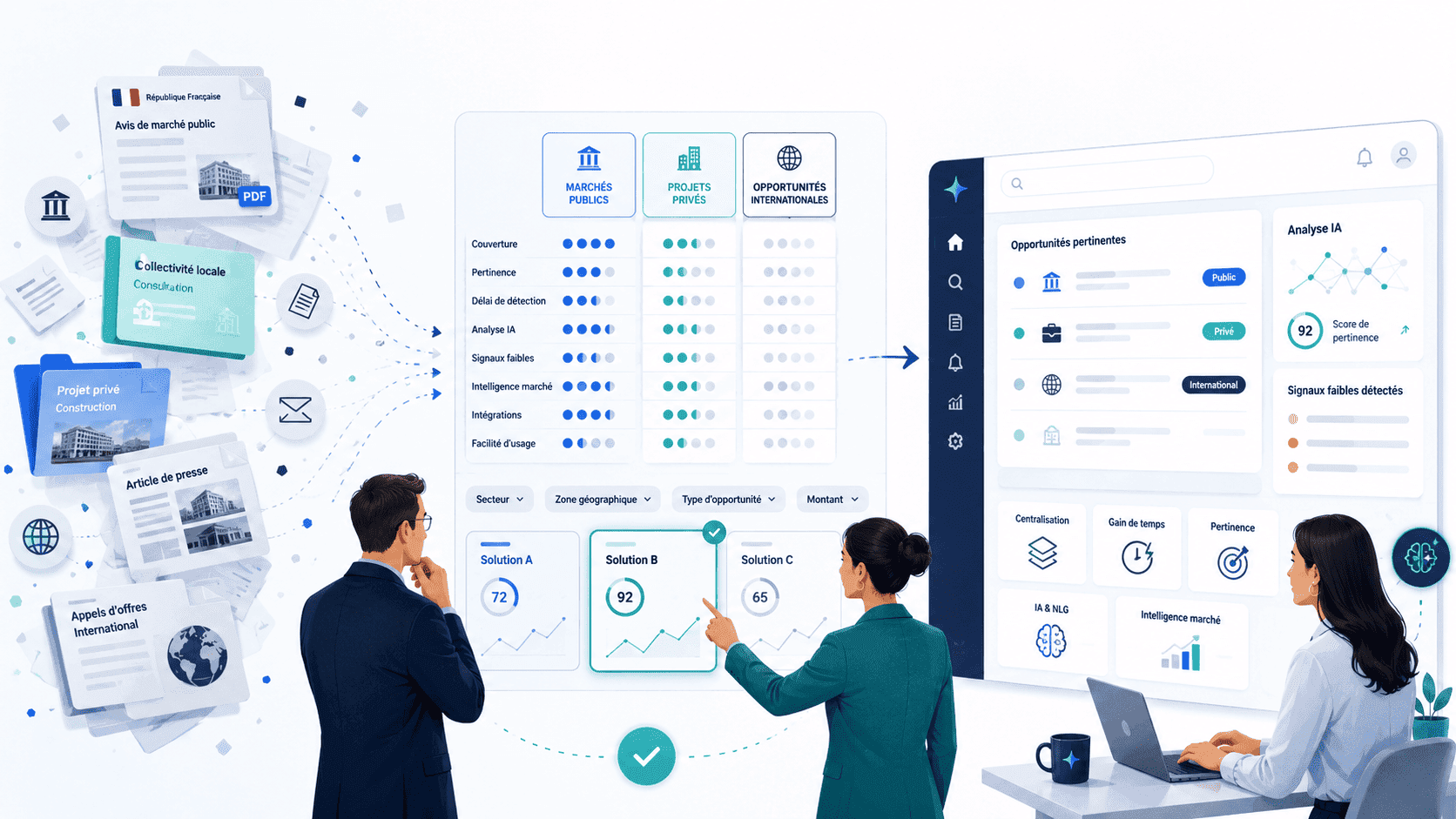
Tender monitoring software: how to choose a solution for public and private markets?
Tender monitoring software helps detect, centralise, qualify, and track relevant public tenders before their submission deadline.
Choosing a tender monitoring solution in France has become more complex. Companies must compare public platforms, buyer profiles, aggregators, legacy solutions, in-house tools, and AI-enhanced platforms.
The right choice does not depend solely on price or the number of announcements received. An effective solution must cover the right sources, quickly surface tenders, reduce noise, track contract award notices, detect weak signals, integrate private projects when useful, and help teams qualify opportunities through document analysis.
For companies active in France and internationally, another criterion becomes central: the ability to monitor French and international tenders on a single platform. Separate monitoring for France and international markets often creates duplicates, blind spots, and wastes time for sales teams.
Methodological note
This article is published by Deepbloo, a tender monitoring platform. The aim is not to establish a definitive ranking of market players but to offer a framework for comparing the different approaches available: public platforms, aggregators, legacy solutions, in-house tools, general-purpose AI tools, and specialised platforms.
1. Why compare tender monitoring solutions in France?
Comparing tender monitoring solutions helps identify the tool best suited to each company’s geographical, sectoral, and commercial scope.
The French tender monitoring market comprises several types of players. Public platforms provide access to official notices. Buyer profiles directly publish buyer consultations. Aggregators centralise notices from multiple sources. Legacy platforms support companies in detecting and tracking public tenders. More recent solutions integrate more automation, document analysis, upstream signals, and artificial intelligence.
This diversity makes comparison difficult. Two tools might both refer to “tender monitoring” but address very different needs. A local SME tracking a few public buyers does not have the same expectations as a group monitoring several regions, multiple business lines, and various countries.
The central question is therefore not: “What is the best solution on the market?”. The right question is: “Which solution matches the scope, sources, teams, and level of anticipation the company actually needs?”.
This typology shows that a tender monitoring solution should not be evaluated solely as a search engine for notices but as a complete system for collecting, qualifying, anticipating, and supporting commercial decision-making.
Key players visible in the French market include BOAMP, PLACE, Marchés Online, e-marchespublics, France Marchés, Klekoon, Wanao, Spigao, Explore, Vecteur Plus, DoubleTrade, Achatpublic, and Deepbloo. These players do not all fall into the same category, and their functionalities evolve regularly. Before choosing a solution, a company must therefore test the tools on a real sample of tenders, compare the results in its own sector, verify the sources covered, and measure the time genuinely saved.
Key takeaway
A tender monitoring solution should be evaluated according to actual business needs, not just the volume of notices displayed.
2. Free monitoring or specialised platform: what are the concrete differences?
Free monitoring may suffice for a limited scope, but a specialised platform becomes necessary when sources, territories, and business criteria multiply.
The following table compares free monitoring based on public sources with a specialised platform like Deepbloo. The aim is not to oppose free and subscription-based, but to show the differences in coverage, anticipation, analysis, and commercial exploitation.
| Comparison Criterion | Free monitoring / public sources | Deepbloo |
|---|---|---|
| Centralised public tender search | Manual consultation of numerous sources: BOAMP, PLACE, TED, buyer profiles, regional platforms, local authority websites or local portals. | Centralisation of tenders in France and internationally, information from local authorities, deliberations, private projects, press reviews, administrative acts and documents. |
| Speed of tender detection | Depends on the frequency of manual consultation and the number of sources followed by the teams. | Deepbloo monitors sources daily to integrate new notices, generally within 24 hours of their publication. |
| Source coverage in France | National sources are accessible, but regional, local, and sectoral platforms must be identified and consulted separately. | Deepbloo covers national, regional, and local platforms, as well as hundreds of sources scattered across France. |
| International coverage | Manual international monitoring involves searching country by country, often in multiple languages and on heterogeneous platforms. | Deepbloo allows tracking tenders in France and internationally from a single platform, with coverage used by leading clients for their export monitoring. |
| Access to private projects | Very limited. Private projects require specific monitoring of permits, authorisations, announcements, local press, or administrative documents. | Deepbloo includes private projects at different stages of development: intentions, building permits, authorisation requests, public announcements, and very early-stage signals. |
| Contract award notices | Award notices are public, but large-scale manual tracking remains difficult and time-consuming. | Deepbloo tracks award notices to identify winners, amounts, active buyers, and future contract renewals. |
| Weak signal detection | Upstream monitoring requires separate consultation of local press, deliberations, authorisations, budgets, public inquiries, and administrative documents. | Deepbloo helps detect weak signals before the official publication of tenders, particularly in infrastructure, energy, environment, waste, and construction. |
| AI analysis of tender documents | ITTs, technical specifications (CCTP), administrative clauses (CCAP), annexes, and technical documents must be read manually by teams. | Deepbloo analyses tender documents with AI, extracts key information, and can generate a complete summary of the tender in minutes. |
| Go/no-go decision support | The decision relies on a complete manual reading of the file and the teams’ experience. | Deepbloo facilitates an initial go/no-go analysis by quickly identifying the market’s purpose, requirements, key dates, selection criteria, and points of vigilance. |
| Custom business criteria | Searches primarily rely on keywords, CPV codes, and filters available on each platform. | Thanks to its AI work with the University of Montpellier and the University of Bordeaux, Deepbloo develops models capable of identifying specific business criteria for each activity segment. |
| Noise reduction | Broad alerts often generate many false positives, which teams must manually sort. | Deepbloo allows using exclusions, precise expressions, advanced queries, and natural language search to reduce noise and improve result relevance. |
| Natural language search | Searches are generally limited to keywords, filters, or predefined categories. | Deepbloo integrates natural language search to formulate complex business needs without relying solely on keywords or CPV codes. |
| AI assistant connected to data | Free tools do not allow direct querying of a consolidated database of tenders and projects. | Deepbloo develops an AI assistant connected to its database, capable of querying market trends, generating reports, and analysing opportunities by sector, country, or project type. |
| Source customisation | Adding sources relies on manual monitoring or specific internal development. | Deepbloo can add sources on demand according to the company’s business, geographical, or sectoral needs. |
| CRM, API, and data utilisation | Data often has to be copied, reprocessed, or exported manually. | Deepbloo can interface with CRM tools, offer API usage, and facilitate data utilisation in existing business processes. |
| Contact search and lead generation | Contacts, companies, and decision-makers must be searched manually after identifying a tender. | Deepbloo allows searching for companies, contacts, and emails related to opportunities, then exporting data to Excel to facilitate lead generation. |
| Ergonomics and daily use | Monitoring relies on multiple websites, email alerts, Excel files, and manual processes. | Deepbloo offers a modern interface to search, filter, analyse, save, share, and track opportunities in a single environment. |
| Apparent cost | Free, but with significant hidden costs in human time, risk of oversight, and missed opportunities. | Paid subscription, but designed to reduce monitoring time, improve qualification, and limit missed tenders. |
Free monitoring may suffice for a company that monitors a few sources within a local scope. A specialised platform becomes more relevant when monitoring needs to cover multiple territories, multiple business lines, private projects, award notices, weak signals, or international markets.
The difference between simple tender monitoring and a commercial intelligence platform lies in the ability to transform scattered data into qualified, anticipated, and directly actionable opportunities.
Key takeaway
Free monitoring provides access to published information, while a specialised platform enables structuring, qualifying, and exploiting this information at scale.
3. Why should France and international be considered together?
A platform covering France and international markets allows companies to track national and export opportunities in the same monitoring environment.
Many companies begin by structuring their monitoring in France. This approach is logical when sales teams primarily target French public buyers. But the situation becomes more complex when the company also wants to monitor European, African, Middle Eastern, or international markets.
Separate French and international monitoring creates several problems. Teams must consult multiple tools. Search criteria are not harmonised. Duplicates become difficult to manage. Export opportunities can remain isolated from the main sales pipeline. Cross-border tenders or projects led by international players may also be poorly tracked.
For companies active in energy, environment, infrastructure, construction, water, waste, transport, telecommunications, or technical services, French and international markets often follow similar logics: large public buyers, funders, operators, local authorities, public agencies, public enterprises, and technical project owners.
A single platform therefore facilitates market comparison, country prioritisation, opportunity tracking, and commercial capitalisation. Teams can search for the same business need in France and internationally, compare projects, and more quickly identify the most active areas.
Deepbloo was designed with this logic: to enable companies to track public tenders in France and many other countries from a single environment, with sectoral filters, analysis adapted to technical professions, and a database usable by sales teams.
To explore the categories covered, visit the calls for tenders solutions by sector page. For an approach focused on the French market, visit the tender monitoring platform in France page. For an export approach, visit the international calls for tenders page.
Key takeaway
A company targeting both France and export markets should avoid artificially separating its national and international monitoring.
4. Why do AI and weak signals change the value of monitoring?
Artificial intelligence and weak signals transform tender monitoring into a tool for anticipation, qualification, and commercial decision support.
In many sectors, waiting for the tender to be published is already arriving late. Large public or semi-public projects are often preceded by studies, budgetary arbitrations, deliberations, political announcements, authorisation requests, public inquiries, or private projects.
This logic is particularly visible in infrastructure markets. A project for a district heating network, solar carports, a sewage treatment plant, a sorting centre, energy renovation, urban transport, or fibre optics can be detected long before the official consultation.
A solution limited to published tenders therefore only meets part of the need. A more advanced solution should help companies identify upstream signals, track active buyers, understand a project’s trajectory, and prepare for commercial prospecting before the competitive bidding phase.
Artificial intelligence adds a second breakthrough. Tenders are not just short notices. Files can contain an invitation to tender (ITT), particular technical clauses (CCTP), particular administrative clauses (CCAP), annexes, price schedules, plans, contractual documents, and compliance requirements.
Manually reading these documents is time-consuming. Teams must understand the purpose of the tender, key dates, scoring criteria, technical requirements, documents to be provided, requested references, and potential risks. A misreading can lead to responding to an unsuitable tender or missing an interesting opportunity.
AI can accelerate this step. An AI-enhanced platform can summarise documents, extract key information, identify business criteria, produce an initial go/no-go analysis, and help teams make decisions faster.
The aim is not to replace commercial or technical expertise. The aim is to give teams a structured first reading, to focus human time on the most relevant markets.
At Deepbloo, AI document analysis is central to the platform. The solution relies notably on work carried out with academic partners such as the University of Montpellier and the University of Bordeaux to improve the automatic qualification of tenders, document reading, and opportunity prioritisation.
To delve deeper into this topic, read our article on how artificial intelligence is revolutionising tender monitoring in France and internationally. For a deeper understanding of anticipation logic, also consult our article on how to anticipate contract renewals.
Key takeaway
Monitoring limited to published tenders informs teams, while monitoring enhanced by AI and weak signals helps anticipate markets.
5. How to concretely choose the right monitoring solution?
Choosing a tender monitoring solution requires testing coverage, accuracy, document analysis, and integration into the sales process.
The first step is to define the geographical scope. A company must know if the monitoring concerns only France, several regions, Europe, Africa, the Middle East, or broader international coverage.
The second step is to list priority sectors. A company in energy infrastructure does not have the same needs as a digital service provider, a consulting firm, a construction company, or a public equipment supplier.
The third step is to identify critical sources. Some general sources are essential, but certain tenders may also appear on local buyer profiles, local authority websites, sectoral platforms, or specialised publications.
The fourth step is to test the results. The best test is to compare several solutions using the same keywords, sectors, buyers, and territories over a given period.
The fifth step is to evaluate qualification. A good platform should not just find many tenders. A good platform should allow quickly identifying truly relevant tenders.
The sixth step is to test AI analysis on real documents. A useful tool should help teams read ITTs, CCTPs, CCAPs, and annexes, then make an initial go/no-go decision.
The seventh step is to measure time saved. A monitoring solution should reduce internal workload, improve detection, accelerate qualification, and facilitate commercial collaboration.
Decision Checklist
- Define the areas to monitor: France, regions, Europe, Africa, the Middle East, or internationally.
- List priority sectors: energy, environment, construction, waste, transport, telecommunications, or technical services.
- Identify critical sources: national platforms, buyer profiles, local authorities, press, private projects, or sectoral sources.
- Check the speed of notice integration after publication.
- Test the relevance of results for real business queries.
- Check coverage of award notices and weak signals.
- Test AI analysis on several tender documents.
- Measure the time saved by sales and technical teams.
Key takeaway
The best choice is based on a real test: same criteria, same sources, same sectors, and comparison of time saved by teams.
Conclusion
Choosing a tender monitoring solution in France is not just about comparing prices or volumes of notices. The right choice depends on the actual coverage of sources, speed of detection, targeting quality, access to award notices, detection of weak signals, private projects, AI analysis, and the ability to monitor France and internationally on a single platform.
The French market includes many useful players, but not all meet the same need. A company must therefore start from its commercial organisation, its priority sectors, and its level of ambition.
For companies looking to structure comprehensive monitoring, anticipate markets, and qualify opportunities faster, Deepbloo offers an approach focused on data, artificial intelligence, upstream signals, and France-plus-international coverage.
In summary
- A monitoring solution must be chosen according to the company’s real need, not just the volume of notices.
- The speed of detection and the exhaustiveness of sources remain fundamental criteria.
- Free monitoring may suffice for a limited scope but becomes limited as sources multiply.
- Award notices allow identifying winners, amounts, and future renewals.
- Private projects and weak signals allow anticipating certain tenders before their publication.
- AI becomes essential for reading documents, extracting business criteria, and accelerating go/no-go decisions.
- A single France and international platform avoids blind spots for companies active in export.
- Deepbloo positions itself as an augmented monitoring platform for companies that want to structure, anticipate, and qualify their commercial opportunities.
Frequently asked questions
What is the best tender monitoring software in France?
Monitoring software primarily serves to detect, centralise, and qualify opportunities. A response tool intervenes after market selection to analyse the file, prepare documents, and assist with offer drafting. Both functions can be combined in one solution or handled by separate tools.
Why is tender collection difficult to automate with AI agents?
Collection requires regularly monitoring numerous sources, managing heterogeneous formats, retrieving documents, processing duplicates, and tracking updates. AI agents can assist certain operations, but reliable large-scale collection also requires a specialised infrastructure.
What is a tender monitoring API used for?
A monitoring API allows a company to automatically access opportunity information and utilise it within its own systems. Depending on the services offered, it can facilitate CRM integration, market tracking, or document access.
Why are contract award notices important in a monitoring solution?
Contract award notices help identify winners, awarded amounts, active buyers, and probable renewal dates. They can also be used to prospect companies that have won contracts.
Why are private projects useful in commercial monitoring?
Private projects help identify opportunities that do not always immediately go through a public tender. They provide a broader view of the market and future needs.
Is artificial intelligence useful for analysing tenders?
Yes. Artificial intelligence can summarise documents, extract selection criteria, identify administrative requirements, and help teams make a go/no-go decision faster.
Why choose a platform covering France and internationally?
A platform covering France and internationally allows centralising national and export opportunities in a single tool. This approach reduces duplicates, blind spots, and team dispersion.