Blog
How to anticipate contract renewals
by Alexandre Guillemot 7 min read
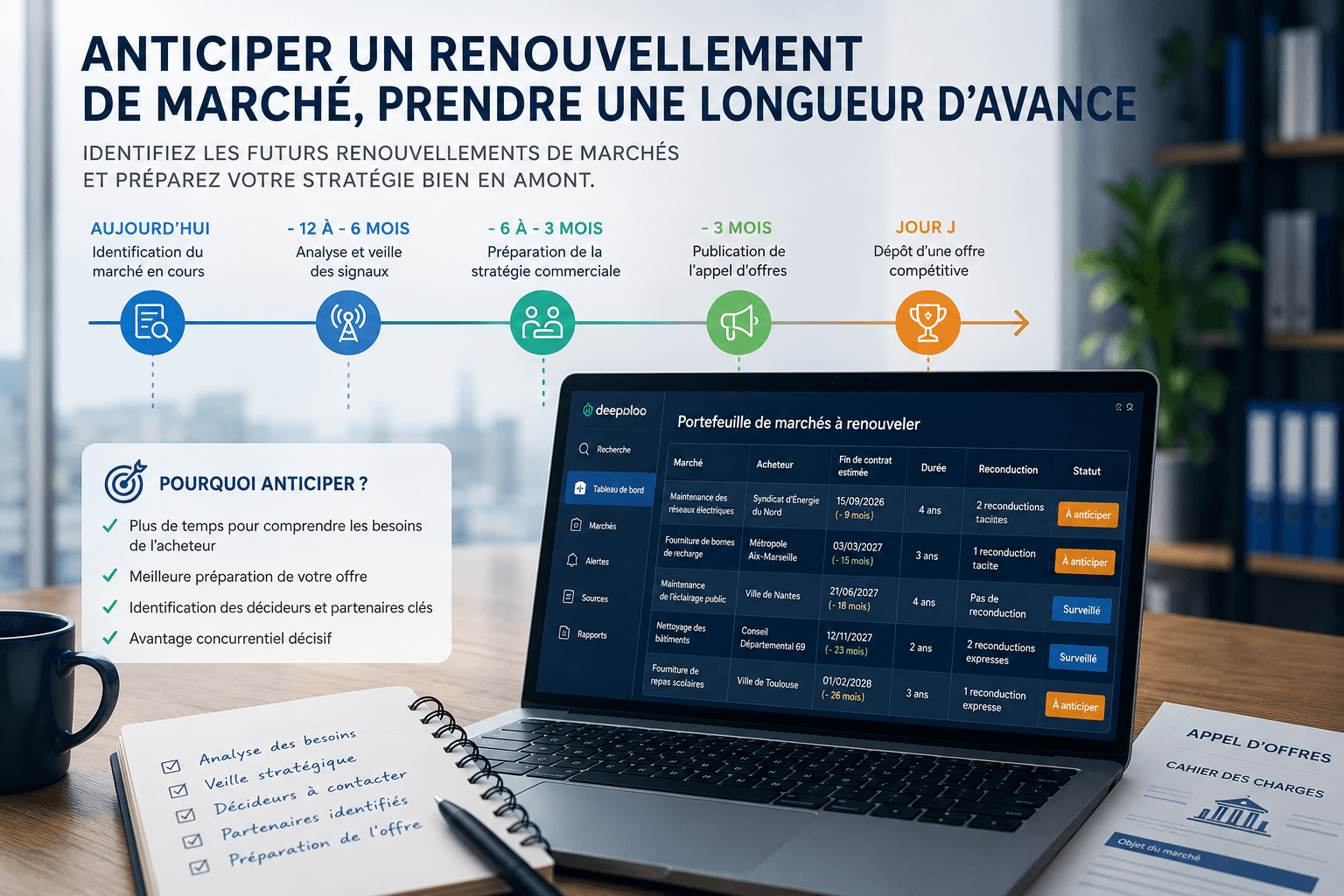
How to anticipate contract renewals?
Anticipating a contract renewal involves identifying, several months or even years before their publication, public contracts that are nearing expiry, in order to prepare a commercial strategy in advance.
Many companies focus their efforts on tenders only upon their publication. However, in many sectors, the best opportunities are prepared well before the official opening of the consultation. Identifying contracts that are soon to expire allows companies to anticipate buyer needs, meet decision-makers, build partnerships, and prepare a much more competitive response.
The renewal of a public contract often represents a more predictable opportunity than a new project. A maintenance, supply, or service contract naturally comes to an end and will, in most cases, need to be renewed or replaced. The entire challenge is therefore to identify these future renewals early enough.
1. Why anticipating a contract renewal constitutes a competitive advantage?
Anticipating a renewal means identifying the upcoming re-tendering of a public contract several months before its publication.
Anticipating renewals allows companies to prepare their commercial strategy before the official publication of a call for tenders.
When a contract is published, much of the preparatory work has already been carried out by the public buyer. Needs are defined, budgets are validated, and the timeline is often long established. Companies discovering the project at this stage have little time to understand the context and build a differentiated offer.
Conversely, identifying a future renewal allows for working much further upstream. Sales teams can monitor the evolution of the need, analyse previous contracts, understand the buyer’s expectations, and identify technical developments likely to be integrated into the future specifications.
In some sectors such as electrical network maintenance tenders, fibre optics tenders, charging station tenders, hydrogen tenders, gas network tenders or photovoltaic tenders, contracts are often renewed regularly, making their anticipation particularly relevant.
Key takeaway
A contract renewal often constitutes a more predictable opportunity than a new project, as its existence is already known several months before the publication of the future call for tenders.
2. What are the best indicators for anticipating a renewal?
Award notices, initial contract documents, and contractual modifications are the main sources for estimating the date of a future renewal.
Several public sources make it possible to identify future renewals well before the publication of the new call for tenders.
The primary indicator is naturally the award notice of the initial contract. This generally specifies:
- the contract holder;
- the awarded amount;
- the award date;
- the contract duration;
- any renewal periods.
This information allows for a good estimation of the probable renewal period.
Public buyers also publish additional information throughout the life of the contract: amendments, modifications, extensions, budgetary decisions, or new deliberations. These documents serve as signals to refine predictions.
To delve deeper into this topic, consult our article (Public Contract Award Notices: How to leverage them to develop business?).
Beyond award notices, the initial contract’s consultation file often contains valuable information for anticipating a future renewal. It is common for the specifications or the commitment act to specify from the outset the contract duration, the number of possible renewals, and the renewal terms, especially when renewal is tacit. When the contract’s start date is known, it becomes relatively simple to estimate when the contract will expire and be likely to be re-tendered.
Even when this date is not explicitly indicated, the tender publication date and the deadline for submission of offers generally allow for a good estimation of the contract start. This approach allows for anticipating the publication of a future tender several months, or even years, in advance, and organising a commercial strategy well before the consultation opens.
Key takeaway
The combination of award notices, contract duration, and weak signals makes it possible to estimate the probable publication date of a future contract. Furthermore, the contract duration and renewal terms in the initial contract often allow for precise anticipation of the probable date of a future renewal.
3. How to build a renewal monitoring strategy?
A renewal monitoring strategy relies on identifying current contracts, tracking their expiry dates, and anticipating future re-tendering. Thus, an effective strategy relies on continuous monitoring of existing contracts rather than just detecting new tenders.
The first step is to identify strategic contracts won by key players in the sector. The objective is not only to know the published tenders, but above all to build a database of active contracts including their holders, amounts, and expiry dates.
Once this mapping is done, companies can create specific alerts before the estimated renewal dates. This gives them the necessary time to prepare their commercial prospecting, meet buyers, or strengthen their market knowledge.
A monitoring platform also automatically aggregates award notices, contract modifications, and new tenders to track each contract throughout its lifecycle.
This approach is particularly effective in sectors such as airport infrastructure, electrical networks, telecommunications, smart cities, district cooling networks, renewable energy or soft and active mobility, where public contracts represent a significant part of the activity.
A complementary approach consists of building a monitoring base from the tenders themselves. When a consultation file specifies the contract duration and any renewal periods, it becomes possible to immediately identify contracts that will likely be renewed in the coming years. Even in the absence of an award notice, the tender publication date, the deadline for submission of offers, and the contractual duration generally allow for a good estimation of the renewal period. Companies can thus gradually build a portfolio of strategic contracts, track their expiry dates, and anticipate future consultations several months in advance. In practice, the most effective strategy is to cross-reference information from the initial tender with that from award notices to get the most complete picture possible. When this reconciliation is not possible, the analysis of the original contract already constitutes a very relevant basis for organising renewal monitoring.
Key takeaway
Renewal monitoring transforms reactive prospecting into an anticipated commercial strategy.
4. How does a monitoring platform facilitate this anticipation?
A monitoring platform allows for centralising existing contracts, identifying their probable expiry dates, and automatically tracking new signals indicating a future renewal.
Performing this work manually quickly becomes complex. Information is spread across national platforms, buyer profiles, local authorities, regulatory publications, and various administrative notices.
A monitoring solution, conversely, groups this information in a single interface, allows searching for contracts by holder, buyer, sector, or contract duration, and automatically organises the monitoring.
Artificial intelligence brings additional value by structuring data from public documents and facilitating the identification of truly relevant contracts.
To discover how these technologies improve public contract monitoring, consult (How is AI revolutionising tender monitoring in France and internationally?).
An effective monitoring platform does not just aggregate tenders. The most advanced solutions use artificial intelligence to automatically analyse consultation documents and extract key information such as the contract start date, its duration, the estimated end date, the number of planned renewals, or the renewal terms. This information is then presented in a structured interface, allowing the main characteristics of hundreds of contracts to be viewed in a single table without having to open each file individually. Such an approach significantly facilitates the construction and monitoring of a portfolio of contracts to be renewed.
Some monitoring platforms automatically structure information from public contracts to facilitate the identification of probable renewals. At Deepbloo, artificial intelligence models notably enable the automatic extraction of contract duration, renewal terms, and estimated expiry dates from consultation documents.
Key takeaway
Monitoring automation allows more time to be dedicated to commercial strategy than to information gathering.
Conclusion
Anticipating a contract renewal is not simply about monitoring new tenders. An effective strategy relies on analysing the complete lifecycle of public contracts, from their award to their future re-tendering.
Companies capable of identifying these expiry dates several months in advance gain a significant competitive advantage: they can better understand buyer needs, prepare their offers, and develop much more targeted prospecting.
In summary
- Award notices are the best starting point for anticipating a renewal.
- Contract duration allows for estimating the next consultation.
- Amendments, deliberations, and weak signals refine this estimation.
- A monitoring platform automates the tracking of thousands of contracts.
- Anticipation significantly improves commercial preparation.
Frequently asked questions
How to anticipate a public contract renewal?
Anticipating a renewal relies on analysing award notices, contract durations, renewal clauses, and initial contract documents to estimate the next re-tendering.
Do award notices allow for predicting future calls for tenders?
Yes. Award notices generally indicate the holder, the amount, the contract duration, and sometimes the renewal terms, which allows for estimating the probable date of a future renewal.
Can a renewal be anticipated without an award notice?
Yes. The initial contract's consultation file often contains the contract duration and any renewals. Failing that, the publication date and the deadline for submission of offers generally allow for estimating the contract's start date with good accuracy.
Why track public contract renewals?
Tracking renewals allows for preparing a commercial strategy several months before the publication of a new call for tenders, identifying recurring buyers, and improving the success rate of applications.
How does a monitoring platform facilitate the anticipation of renewals?
A monitoring platform centralises calls for tenders, automatically analyses contractual documents using artificial intelligence, and extracts key information such as duration, renewals, and estimated renewal dates.