Blog
Tender monitoring in France: why companies still miss out
by Alexandre Guillemot 14 min read
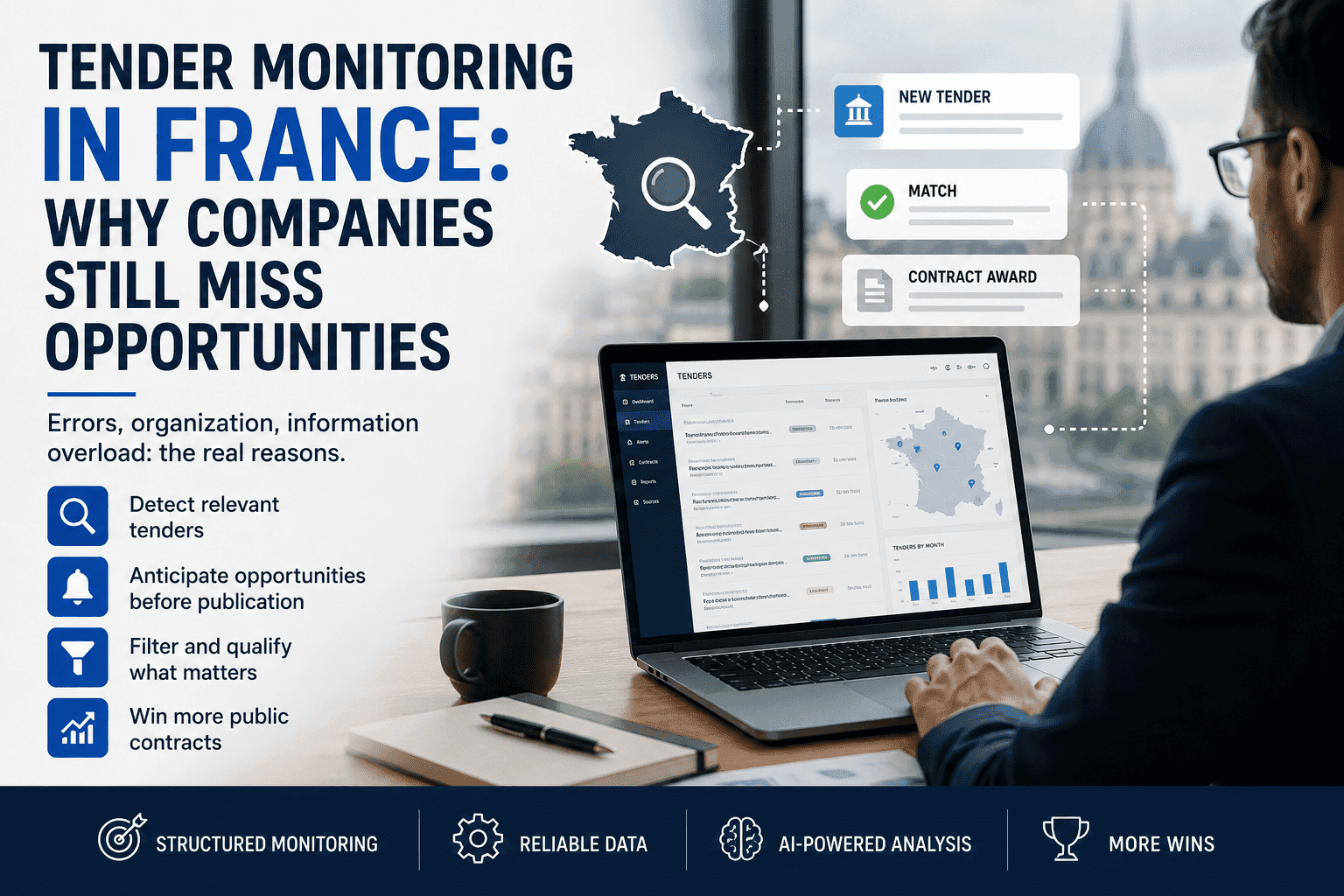
Tender monitoring in France: why do companies still miss out on contracts?
Tender monitoring in France involves identifying, qualifying, and tracking relevant public contracts before they are missed, poorly analysed, or processed too late.
Many companies know that public procurement can be a significant business driver. Yet, many continue to miss perfectly accessible tenders, not due to a lack of skills, but due to a lack of organisation, method, or appropriate tools.
The problem is not always with the quality of the offer. It often stems from how opportunities are detected, sorted, analysed, and communicated to sales or technical teams. Overly manual monitoring, insufficient geographical coverage, poor qualification of opportunities, or information overload can be enough to lose significant opportunities.
In some cases, well-structured manual monitoring can work perfectly. In other cases, especially when the geographical, sectoral, or documentary scope widens, a tender monitoring platform becomes essential to avoid information loss and organise reliable business prospecting.
1. Why do companies still miss tenders in France?
Companies still miss tenders in France because business intelligence too often relies on informal habits, ad-hoc searches, or tools ill-suited to the actual volume of information to monitor.
The first mistake is to treat monitoring as a secondary task. An employee consults a few platforms occasionally, receives a few alerts, forwards some links by email, and assumes that most relevant tenders will be detected. This method can work temporarily, but it becomes fragile as soon as multiple sources, regions, or business areas need to be monitored.
Effective monitoring relies on a clear process: defining sources, setting a consultation frequency, qualifying opportunities, distributing responsibilities, and tracking decisions made on each contract. Without this organisation, tenders can be seen too late, poorly transmitted, or forgotten in an inbox.
The challenge is therefore not solely technological. Even before choosing software, a company must know who monitors the markets, according to what criteria, how often, and with what decision-making process. Unstructured monitoring quickly produces two negative effects: missed tenders and unnecessary overload for teams.
Key takeaway
A company does not always miss a tender because it lacks the right solution, but because it has not defined a clear method for detecting, qualifying, and processing opportunities.
2. Lack of structured monitoring: the most common mistake
Structured monitoring involves organising tender surveillance around identified sources, qualification criteria, an internal routine, and a follow-up process.
The most basic mistake is not implementing structured monitoring. Many companies monitor public markets intuitively, without a precise mapping of sources, without a defined frequency, and without a shared sorting method among teams.
This situation is not always problematic at first. When a company operates within a very limited scope, for example, a single region, a few known public buyers, and a very specific business area, manual monitoring may suffice. It is possible to regularly follow a few platforms, consult certain buyer profiles, and create a simple routine with a tracking sheet.
However, manual monitoring becomes insufficient when the scope expands. As soon as a company wishes to monitor multiple regions, several activity families, various types of buyers, or dozens of sources, the risk of error increases sharply. Teams end up no longer knowing which sources have been checked, which markets have been analysed, and which opportunities need to be followed.
In this case, sticking with entirely manual monitoring can cost more than anticipated. The time spent searching, filtering, and verifying information becomes high, while missed contracts can represent a commercial loss far greater than the cost of an appropriate tool. To delve deeper into this topic, read our article on manual tender monitoring versus automated tender monitoring.
Key takeaway
Manual monitoring can work on a small scale but must be organised as an internal process. As soon as the scope becomes large, automation often becomes necessary.
3. Trying to save on a monitoring solution can cost much more
Savings made on a monitoring solution can turn into commercial losses when the company misses significant tenders or allocates too much internal time to monitoring public sources.
Some companies hesitate to invest in a monitoring solution because they believe tenders are already public and freely accessible. This analysis is partly true. Notices are indeed published on public platforms, buyer profiles, legal announcement journals, or specialised portals.
The problem is not theoretical access to information. The problem is the ability to find the right information at the right time. A contract can be published on a little-known local source, poorly categorised, written with unexpected keywords, or associated with an overly general CPV code. An ad-hoc search can therefore easily miss a highly relevant contract.
This error is particularly common in sectors where sources are numerous and technical terms vary: energy, infrastructure, telecommunications, environment, transport, digital, or public equipment. A company monitoring solar tenders, electrical network tenders, or fibre optic tenders often needs to monitor a large number of sources, local authorities, and public operators.
In these situations, the goal is not merely to receive more alerts. The goal is to reduce noise, detect relevant contracts, and allow teams to focus on truly actionable opportunities. A monitoring solution must therefore be evaluated not only on its price but also on its coverage, accuracy, qualification capabilities, and the time it saves teams.
Key takeaway
The cost of inadequate monitoring is measured not only by the saved subscription but by missed contracts, lost time, and business decisions made too late.
4. Believing an in-house automated monitoring system will be easy to build
An in-house automated monitoring system involves developing internal tools capable of collecting, standardising, analysing, and qualifying tenders from numerous public sources.
With recent advances in artificial intelligence, some companies may be tempted to build their own monitoring system. This idea may seem logical: use an AI model to read tenders, generate summaries, produce an initial go/no-go assessment, or help analyse administrative and technical documents.
This approach can work for the analysis of an already identified tender. AI can summarise consultation rules, extract selection criteria, identify required documents, or help understand technical specifications. This is precisely one of AI’s major contributions to business intelligence. To learn more about this topic, read our article on how artificial intelligence is revolutionising tender monitoring in France and internationally.
However, using AI to build exhaustive monitoring is much more complex. The main difficulty is not just analysing tenders, but knowing where to find them, how to collect them, how to avoid duplicates, how to manage format changes, how to monitor local sources, and how to maintain the system over time.
A company can ask AI to generate code to retrieve information from certain sources. But it must already know these sources, understand their structure, manage updates, control data quality, and maintain connectors when websites change. Very quickly, the project becomes a technical project in its own right.
For a company whose core business is not public data or automated public procurement monitoring, a turnkey solution can therefore be more rational. It allows benefiting from an infrastructure already designed to collect, enrich, and qualify opportunities, without tying up internal resources on a complex project.
Key takeaway
AI can greatly improve tender analysis, but it alone does not replace a monitoring infrastructure capable of sustainably monitoring dozens or hundreds of sources.
5. Choosing the wrong monitoring solution
Choosing a monitoring solution involves comparing the company’s real needs with the coverage, sources, features, and analysis capabilities offered by each tool.
Not all monitoring solutions meet the same need. Some are suitable for general national monitoring. Others are more relevant for sectoral, international, competitive, or weak signal-oriented monitoring. A common mistake is choosing a tool without clearly defining the monitoring scope.
The first question concerns geography. Is the company only looking for tenders in France, or does it also need to monitor Europe, Africa, the Middle East, or other international areas? National and international monitoring do not pose the same challenges regarding sources, language, standardisation, and analysis.
The second question concerns the type of opportunities sought. Some companies respond directly to tenders. Others use award notices to identify contract holders and offer them services, subcontracting, or supplies. In this case, monitoring must cover not only tenders but also awards.
The third question concerns weak signals. A company may need to monitor local press, local authority deliberations, administrative authorisations, public inquiries, private projects, or competitive intelligence to anticipate markets before their official publication. This is particularly important in sectors where projects are prepared well before the tendering phase.
The fourth question concerns specific sources. In some business areas, a few local, sectoral, or institutional sources can be decisive. It is therefore important to check whether the solution can add sources on demand, customise monitoring criteria, and adapt surveillance to the company’s actual needs. Deepbloo notably allows monitoring tenders by sector and organising monitoring according to activity areas, countries, and project types.
Simple matrix for choosing a monitoring solution
| Question to ask | Why it’s important |
|---|---|
| Is the scope local, national, or international? | Source coverage varies greatly depending on the area monitored. |
| Is the company looking for tenders or also awards? | Commercial uses differ depending on the target. |
| Are weak signals useful for the sales cycle? | Certain markets can be anticipated before publication. |
| Are industry-specific sources well covered? | A good solution must include the sources that truly matter for the sector. |
| Does the tool allow for quick qualification of tenders? | The volume of information must be reduced to actionable opportunities. |
Key takeaway
The right monitoring tool is not necessarily the one that promises the largest volume of data, but the one that covers the right sources and qualifies the right markets for the right commercial use.
6. Waiting for market publication instead of anticipating
Anticipating a public contract involves identifying signals announcing a future consultation before the official tender publication.
Another common mistake is waiting for the tender to be published before showing interest. This approach is too late in many sectors. When the contract officially appears, the buyer has often already defined the need, timeline, criteria, and budget.
Effective monitoring must, of course, allow for alerts on the day of publication. Speed remains important, as some response deadlines are short, and teams must be able to analyse the file immediately. But monitoring should not be limited to D-day.
Several methods allow for market anticipation. The first is to follow award notices to identify contracts won, their duration, and their probable renewal date. The second is to analyse the tenders themselves to identify the contract duration, possible renewals, and the probable re-tendering period. To delve deeper into this topic, read our article on how to anticipate contract renewals.
The third method is to monitor weak signals: press articles, budgetary decisions, municipal deliberations, administrative authorisations, public inquiries, private projects, or institutional announcements. This information can sometimes identify a project several months before the official publication of a tender.
From a commercial perspective, the best scenario is therefore not just receiving the tender quickly. The best scenario is knowing about the project before its publication, understanding its context, and being ready when the consultation becomes official.
Key takeaway
Effective monitoring is not just about receiving published tenders. It is also about anticipating future markets before their official appearance.
7. Not verifying the completeness of monitored sources
The completeness of monitoring depends on the ability to identify, track, and control the sources truly relevant to a business area, a geographical zone, and a type of buyer.
A company may have a monitoring solution, alerts, and internal organisation, yet still miss tenders. The reason is simple: some important sources are not covered or are not properly monitored.
The first task is therefore to establish a list of critical sources. This list may include national platforms, buyer profiles of major public accounts, local authorities, hospitals, energy syndicates, social landlords, ports, airports, transport operators, or specialised organisations depending on the sector concerned.
This verification is particularly important for companies operating in highly fragmented markets. Road infrastructure tenders, logistics and supply chain tenders, port infrastructure tenders, or artificial intelligence tenders can be published by very different actors, on very diverse sources.
Good practice involves regularly comparing tenders found through monitoring with those identified by sales representatives, partners, clients, or competitors. If relevant tenders are discovered outside the system, it means coverage needs to be adjusted.
Key takeaway
Reliable monitoring relies on controlled coverage. Companies must verify that the decisive sources in their field of activity are properly monitored.
8. Overloading teams with information
Information overload occurs when teams receive too many alerts, too many documents, or too many poorly qualified opportunities to make the right decisions quickly.
Missing a contract does not always mean never having seen it. It often happens that a tender has indeed been detected, but it is drowned in an overly large volume of alerts, documents, and unqualified information.
This overload creates several problems. Teams waste time opening irrelevant files. Strategic markets are not always prioritised. Decision-making times lengthen. Employees responsible for monitoring end up transmitting too much information to sales teams, who then don’t know which opportunities to tackle first.
Automated document analysis can reduce this burden. With one click, it becomes possible to get a summary of consultation rules, selection criteria, required documents, key dates, and technical elements of the specifications. This capability allows for faster go/no-go decisions and avoids unnecessarily mobilising teams on unsuitable markets.
At Deepbloo, the analysis of specifications relies notably on artificial intelligence models to help companies quickly understand detected tenders, qualify their relevance, and structure their commercial decision. The goal is not to replace business expertise, but to reduce the time spent reading documents and accelerate qualification.
Key takeaway
The volume of tenders is only valuable if teams can quickly qualify relevant markets and discard secondary opportunities.
9. Underestimating the organisation required to respond to tenders
Responding to tenders requires dedicated organisation, because detecting a market is not enough to produce a strong, compliant, and competitive application.
A final mistake is believing that finding tenders is enough to quickly develop revenue in the public sector. Monitoring is essential, but it is only the first step in the commercial process.
Responding to a public contract requires time, method, and a good understanding of consultation rules. Teams must analyse the need, verify selection criteria, prepare administrative documents, produce a technical offer, build a financial offer, and strictly adhere to deadlines.
In some sectors, requirements can be high. The buyer may ask for comparable references, a certain turnover level, certifications, technical qualifications, environmental standards, CSR commitments, or specific capacity proofs. A company that discovers these requirements too late risks wasting time on a market it cannot properly respond to.
It is therefore preferable to organise a complete chain: monitoring, qualification, go/no-go decision, response preparation, internal validation, and feedback after submission. A person or team dedicated to business intelligence makes this process more reliable and regular.
Key takeaway
Tender monitoring must be integrated into a complete sales organisation. Detecting a market is not enough if the company does not have the capacity to analyse and respond to it correctly.
Conclusion
Companies don’t miss tenders solely due to a lack of information. They miss them because their monitoring is sometimes too manual, too unstructured, too limited in sources, or too cluttered with unqualified information.
Effective monitoring relies on three pillars: clear internal organisation, reliable source coverage, and tools capable of transforming information volume into actionable opportunities. Manual monitoring can remain relevant on a small scale. But when markets, territories, and sources multiply, an automated solution often becomes indispensable.
For companies wishing to structure their approach, Deepbloo centralises tenders, tracks awards, identifies upstream signals, and analyses consultation documents from a single public procurement monitoring platform.
In summary
- Companies often miss tenders due to a lack of method rather than a lack of information.
- Manual monitoring can work on a small scale, provided it is structured.
- Automated monitoring becomes necessary when sources, business areas, or geographical zones multiply.
- AI is useful for analysing tenders, but it alone does not replace a reliable collection infrastructure.
- The choice of a solution must depend on the real need: France, international, awards, weak signals, specific sources, and business qualification.
- Effective monitoring must also allow for anticipating markets before their official publication.
- Information overload can lead to missed tenders, even if detected, if teams lack a clear qualification process.
Frequently asked questions
Why might a company miss tenders in France?
A company might miss tenders because its monitoring is not structured, some sources are not tracked, or detected opportunities are not qualified quickly enough.
Can manual tender monitoring be sufficient?
Yes. Manual monitoring can be sufficient when the geographical, sectoral, and documentary scope is limited. However, it must rely on a clear routine, identified sources, and an internal follow-up process.
When should a company switch to automated monitoring?
Automated monitoring becomes relevant when the company needs to monitor multiple regions, business areas, types of buyers, or a large number of sources. It helps reduce omissions, duplicates, and information overload.
Can artificial intelligence replace a monitoring platform?
No. Artificial intelligence can help analyse, summarise, and qualify tenders, but it alone does not replace an infrastructure capable of sustainably collecting and monitoring numerous sources.
How should a company choose a tender monitoring solution?
The choice should depend on the geographical scope, sectors monitored, required sources, the need to track award notices, interest in weak signals, and the tool's ability to qualify relevant markets.
Why are weak signals important in business intelligence?
Weak signals help identify certain projects before the official tender publication. They can come from local press, public deliberations, administrative authorisations, or project announcements.
How can information overload in tender monitoring be avoided?
Companies must define precise qualification criteria, prioritise strategic markets, automate part of the document analysis, and implement a clear go/no-go decision process.