Blog
How to set up large-scale international tender monitoring
by Alexandre Guillemot 10 min read
How to set up large-scale international tender monitoring
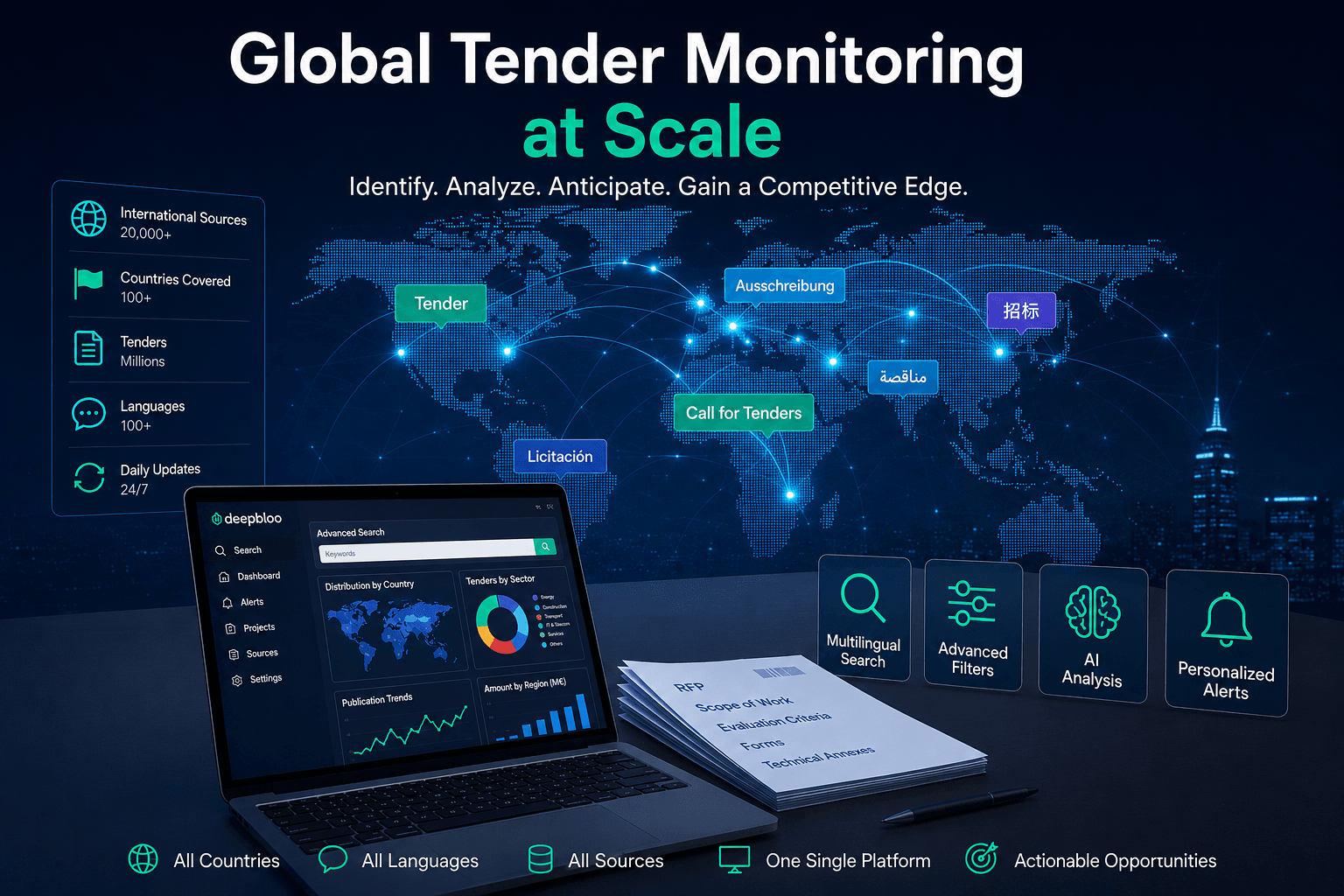
International tender monitoring involves identifying, analysing and qualifying public procurement opportunities published in multiple countries, in multiple languages and by thousands of public buyers worldwide.
For a long time, tender monitoring essentially involved monitoring a few national platforms. This approach remains relevant when a company focuses its activity on a single country or a few very specific countries. However, as soon as a business strategy becomes international, the difficulties change completely. Companies then have to monitor several tens of countries, hundreds of publication platforms, thousands of public buyers and documents published in many languages.
The question is no longer just where to find tenders. The real difficulty lies in building a system capable of quickly detecting relevant opportunities, reducing noise, organising information and allowing sales teams to focus solely on markets with real potential.
To understand more precisely how international tenders in the energy sector are published, you can consult our article (How to identify international tenders in the energy sector).
1. Why international tender monitoring has become a major challenge
International tender monitoring requires monitoring thousands of sources spread across several countries, several languages and several administrative levels.
Contrary to popular belief, there is no single global database grouping all public tenders published worldwide. Each country has its own regulations, platforms, contracting authorities and often several levels of publication. Ministries, local authorities, public companies, port authorities, electricity companies, transport companies or government agencies frequently use different portals.
This fragmentation increases further when working across several continents. European tenders are mainly disseminated via TED, while other regions rely more on national government platforms, development banks, public services or local authorities. Publication procedures, document formats, languages used and levels of detail vary greatly from one country to another.
Companies wishing to deepen their monitoring of European markets can also consult (How to track infrastructure public tenders in Europe).
This reality explains why no organisation can reasonably claim to manually monitor all international markets. The difficulty does not only come from the volume of tenders published every day. The real complexity lies in the number of independent sources that must be consulted daily to obtain a sufficiently exhaustive vision of the market.
Key takeaway:
The difficulty of international monitoring does not lie in the number of tenders published, but in the fragmentation of the sources that disseminate them.
2. Three approaches are currently available for setting up international monitoring
Setting up international monitoring generally relies on three approaches: manual monitoring, specialised national platforms or multi-source international platforms.
Not all companies have the same needs. A company that exclusively carries out projects in Spain will not use the same strategy as an industrial group responding to tenders in fifty countries.
The first approach consists of entirely manual monitoring. This method remains relevant when a company targets a very limited number of countries and each country has very few sources. It consists of identifying the main national platforms, creating accounts on each of them, setting up keyword alerts and receiving new publications daily by email.
However, this solution has significant limitations. Teams have to consult several different interfaces, manage hundreds of alerts, eliminate duplicates and manually search for associated documents. As soon as the geographical scope expands, the time spent administering the monitoring quickly exceeds the time spent analysing opportunities.
It should be noted, however, that even when a company focuses its monitoring on a single country, entirely manual monitoring is not always realistic. Some markets are particularly fragmented and publish tenders on a very large number of national, regional and local platforms. France is a good example: beyond the BOAMP (Read on this subject: How to use the BOAMP to identify public procurement notices in France) or TED, local authorities, buyer profiles, regional platforms and many other sources disseminate daily consultations. In this context, manual monitoring quickly becomes difficult to maintain and risks missing opportunities. Such an approach is therefore only feasible when the number of countries is very limited and each of them has a small number of sources to monitor. To better understand the diversity of French sources, consult our article (Where to find public tenders in France? A comprehensive overview of sources).
A second strategy is to use platforms highly specialised in a national market. This approach often offers excellent depth of coverage. A Slovenian platform will probably cover more local markets in Slovenia than an international platform. A company that focuses its activity on one or two countries therefore has every interest in favouring this solution.
However, this strategy becomes difficult to maintain when the number of countries increases. A company present in fifteen countries would have to multiply subscriptions, interfaces, data formats and working habits. Monitoring then gradually loses coherence and the multiplication of subscriptions considerably increases costs.
The third approach is to use an international platform capable of centralising the main sources from many countries in a single interface. This strategy better meets the needs of industrial groups, engineering companies, consulting firms, equipment suppliers or companies looking for opportunities on a global scale. The objective is no longer to perfectly cover every small local authority but to build a homogeneous and exploitable vision of the main international markets.
Some regions nevertheless require a specific approach, particularly in Africa where national platforms and international donors play a central role. See (How to identify international energy tenders in Africa) and (Finding infrastructure renewable energy advisory tenders in Africa: why it’s still so hard).
Key takeaway:
A local platform maximises depth for one country. An international platform maximises the consistency of a global business strategy.
3. The criteria that truly determine the quality of an international platform
An effective international monitoring platform centralises sources, structures data, facilitates multilingual searches and improves opportunity qualification.
Not all international platforms are created equal. The number of countries covered is an initial indicator, but it remains insufficient to assess the actual quality of a monitoring solution.
The first criterion is naturally source coverage. An effective platform must aggregate the main national platforms, development banks, public enterprises, public services, ministries and major contracting authorities. Extensive coverage mechanically increases the probability of detecting relevant opportunities.
The second criterion concerns data structuring. Simple document collection provides only limited value. Sales teams need directly usable information: buyer, amount, deadline, country, procedure type, lots, sector of activity, associated documents, contact details and selection criteria. The more structured this information is, the faster and more reliable searches become.
Multilingual management is probably one of the most differentiating criteria. An international company cannot reasonably build queries in twenty different languages. The same equipment can be described using very different terminologies from one country to another. Platforms capable of automatically translating notices into a single language allow for the construction of much more robust search strategies and strongly reduce the risk of missing an opportunity published only in a local language.
The richness of the search engine also plays an essential role. Teams must be able to combine geographical, sectoral, technical or documentary criteria, create exclusions, search in technical annexes, filter certain buyers or regions and save complex queries capable of evolving over time.
Finally, artificial intelligence tools are gradually becoming indispensable. Tenders often contain several hundred pages of technical documents. Analysis models can now automatically extract key information, identify selection criteria, summarise technical requirements and facilitate rapid qualification of dossiers. To delve deeper into this approach, you can consult (How Artificial Intelligence is revolutionizing tender monitoring).
Key takeaway:
An effective international platform doesn’t just centralise tenders. An effective platform transforms thousands of documents into directly usable information.
4. Building an effective international strategy
An effective international monitoring strategy combines adapted market coverage, targeted queries and continuous analysis of public opportunities and market signals.
Effective international monitoring does not start with choosing software. Effective monitoring starts with a precise definition of the business scope.
The most successful companies first define priority countries, then sectors of activity, types of buyers, minimum amounts and desired technologies. This step then allows for the progressive construction of increasingly precise queries to reduce documentary noise.
A mature strategy does not rely solely on published tenders. The most successful companies also track project pipelines, international funding, preliminary studies and contract award notices to identify companies that have won contracts likely to generate future subcontracting needs.
This approach becomes particularly relevant in sectors such as (photovoltaic tenders), (hydrogen tenders), (telecommunications tenders), (fibre optics tenders), (electrical network maintenance tenders), (electricity meter tenders), (airport infrastructure tenders) or (soft mobility tenders), where projects often span several years and generate several successive consultations.
The best international strategy is to build a progressive knowledge of the market rather than just looking for tenders published today.
Beyond the tenders themselves, companies often seek to detect weak signals announcing future projects. However, this approach is much more complex to implement on an international scale.
Unlike tenders, which are generally published on identified platforms, weak signals come from a multitude of very heterogeneous sources: local authority deliberations, administrative authorisations, building permits, environmental studies, government decisions, regulatory publications or specialised press. Covering several tens of thousands of sources spread across all administrative levels, in several languages and in dozens of countries, represents a considerable challenge today and remains difficult to achieve exhaustively.
However, two approaches make it possible to obtain an upstream vision of the market:
-
The first consists of integrating an international press watch, capable of bringing out announced projects before the publication of procurement procedures.
-
The second relies on tracking contract award notices, which identify companies that win contracts that have already been funded and quickly engage in commercial approaches with the successful bidders who may need partners, subcontractors or suppliers. To delve deeper into this latter approach, consult our article (Contract award notices: how to leverage them to develop business).
Conclusion
Setting up international monitoring does not mean accumulating thousands of alerts from hundreds of different platforms. An effective strategy relies on the ability to centralise data, structure information, eliminate documentary noise and quickly qualify truly relevant opportunities.
As public procurement markets become more international and more technical, the quality of monitoring constitutes a major competitive advantage. A company capable of identifying opportunities earlier, understanding technical documents in several languages and simultaneously tracking several tens of countries significantly improves its ability to develop its international activity.
Next-generation monitoring platforms do not replace commercial expertise. They allow teams to spend more time analysing projects, building partnerships and preparing competitive offers rather than manually searching for information.
In summary
Effective international monitoring is above all based on a strategy adapted to the desired geographical scope. For a few countries, highly specialised local platforms can offer the best coverage. For an activity spread across several continents, an international platform generally becomes the most efficient solution for centralising data, harmonising languages, structuring information and reducing the time spent searching.
Companies that combine international coverage, an advanced search engine, multilingual management and AI-assisted document analysis today have a significant competitive advantage in identifying opportunities more quickly and developing their activity in international public procurement markets.
Frequently asked questions
How do you set up international tender monitoring?
The first step is to define priority countries, business sectors and buyer types. A platform capable of centralising multiple international sources then considerably simplifies daily monitoring.
Can an international platform cover all tenders worldwide?
No. No single player covers all local publications. International platforms primarily seek to aggregate the main relevant sources to offer consistent coverage of international markets.
Why is multilingual management important?
A large proportion of tenders are published only in the official language of the country. A search limited to English or French therefore risks overlooking important opportunities.
Which sectors benefit most from international monitoring?
The infrastructure, energy, telecommunications, transport, water, construction, electricity network and industrial technology sectors are particularly concerned by international tenders.
Are award notices useful in an international strategy?
Yes. Award notices help identify companies winning contracts and are an excellent source of prospecting for suppliers, subcontractors and service companies.